
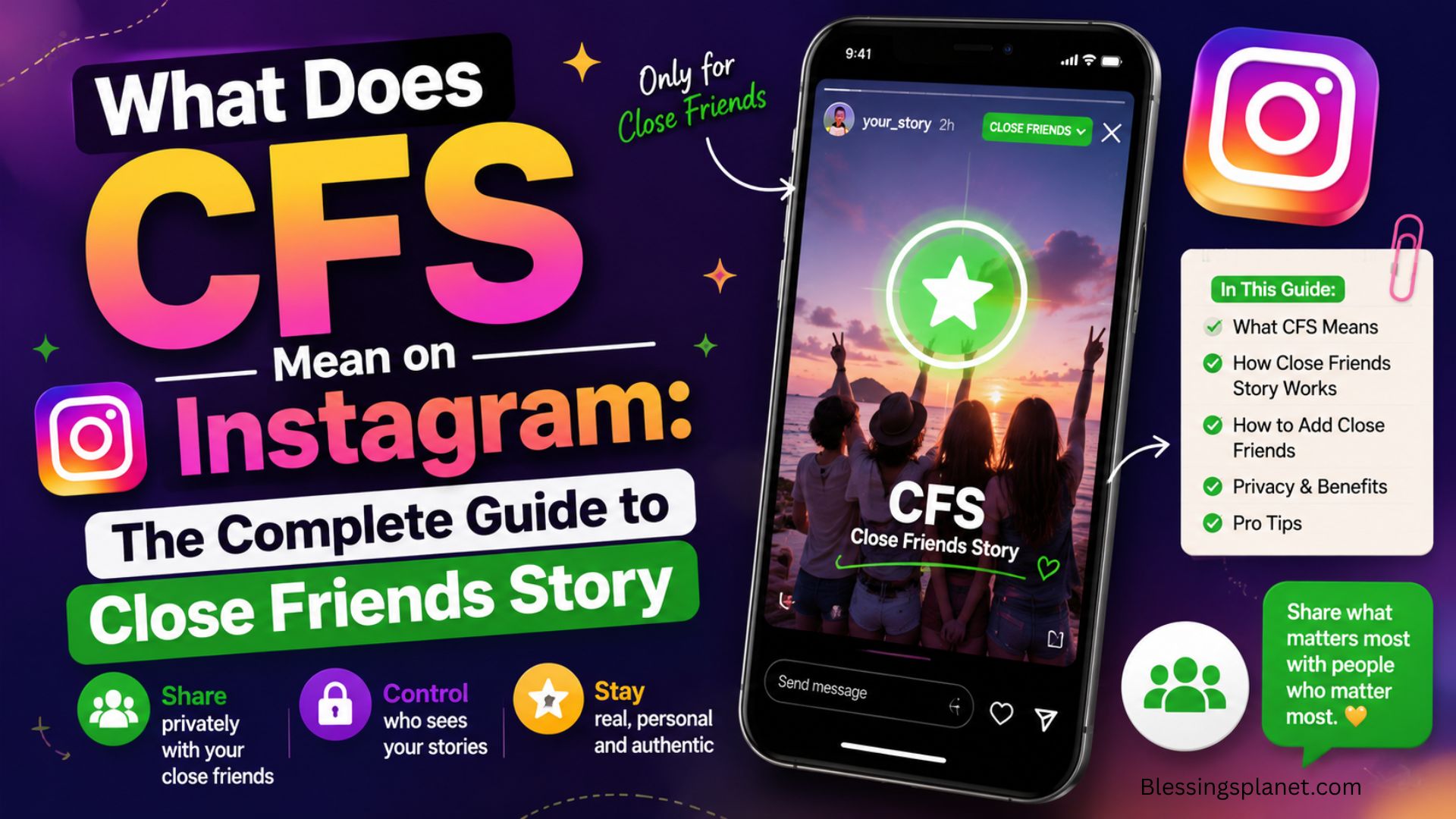
Scroll through Instagram long enough and you’ll eventually run into a comment, a DM, or a caption that simply says “CFS.” No explanation. No context clue. Just three letters sitting there, daring you to guess what they mean.
If you’ve ever paused mid-scroll wondering whether you missed some new internet trend, you’re not alone. Search interest around “what does CFS meaning on Instagram” has spiked recently, and it’s easy to see why. The term shows up constantly in stories, captions, and comments, yet almost nobody explains it outright.
This guide breaks the term down completely — what it means, how it’s used, the psychology behind it, and how to use it yourself without any confusion.
Why “What Does CFS Meaning on Instagram” Is Trending
How Instagram Slang Evolves Rapidly
Instagram slang doesn’t stay still. New abbreviations pop up almost weekly, spread through comment sections, then either fade out or become permanent parts of everyday digital vocabulary. CFS is one of the terms that has stuck around because it describes a real, commonly used feature rather than just a passing joke.
Unlike slang that exists purely for humor, CFS is tied directly to a functional part of the app. That gives it staying power. People aren’t just using it to sound trendy — they’re using it because it accurately describes something they do on the platform almost daily.
Why Understanding Abbreviations Improves Communication
Not knowing what an abbreviation means can genuinely affect how you interact online. Miss the meaning of CFS, and you might misread a caption, respond awkwardly in a DM, or feel excluded from a conversation happening right in front of you.
Digital literacy experts note that abbreviation fluency has become almost as important as traditional literacy for younger social media users, since so much daily communication happens in shorthand. Understanding terms like CFS isn’t about chasing trends for the sake of it — it’s about being able to participate in conversations that are already happening around you.
Where Users Commonly See CFS
CFS typically shows up in three places: story captions, comment replies, and direct messages. Someone might post a story and caption it “CFS only,” or a friend might comment “wait was that CFS?” under a screenshot. It also frequently appears in group chats when someone references something they saw that wasn’t meant for the general public.
Quick Answer: What Does CFS Mean on Instagram
Direct Meaning of CFS
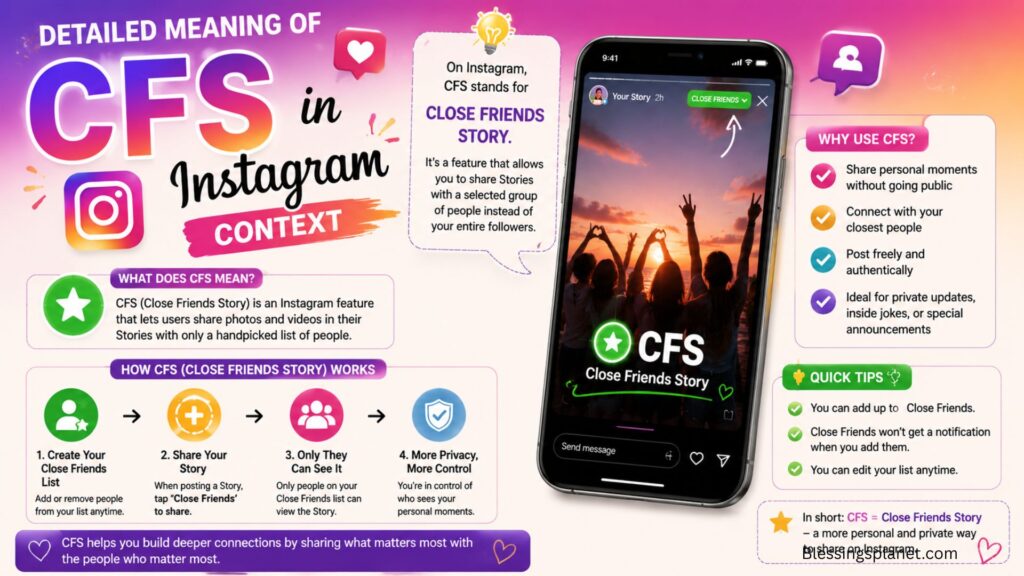
CFS stands for Close Friends Story. That’s it — no hidden layers, no complicated backstory. It refers to a story posted specifically to Instagram’s Close Friends feature, which limits visibility to a hand-picked list of followers rather than everyone who follows you.
CFS as Close Friends Story Explained
Instagram’s Close Friends feature lets users create a private list of selected followers. When a story is shared to that list, it’s marked with a green ring around the profile picture (instead of the standard multicolor ring), signaling to viewers that the content is exclusive. CFS is simply the shorthand people use to refer to that kind of story.
Where CFS Appears in Instagram
You’ll see the term used most often in:
- Story captions (“CFS 🫶”)
- Comments asking to be added (“add me to your CFS”)
- DMs referencing something shared privately
- Bios or highlight titles referencing exclusive content
When People Use the Term
People use CFS whenever they want to flag that content is private, exclusive, or limited to a trusted circle — whether that’s while posting it themselves or when discussing someone else’s story with mutual friends.
Detailed Meaning of CFS in Instagram Context
Close Friends Story Full Breakdown
A Close Friends Story functions exactly like a regular Instagram story in terms of format — photos, videos, stickers, polls, music — but its audience is restricted. Only the people the poster has added to their Close Friends list can view it, reply to it, or see it in their story feed at all.
This creates a smaller, more intimate space within a platform that’s otherwise built for broad, public sharing. It’s Instagram’s answer to the reality that not everything someone wants to share is meant for a following of hundreds or thousands of people.
Difference Between CFS and Regular Story
A regular story is visible to anyone who follows the account (or anyone at all, if the account is public). A CFS is visible only to the specific people on the Close Friends list. The content itself doesn’t have to be different — the difference is purely about audience control.
Visual Indicators of Close Friends Content
The clearest visual cue is the ring color. Standard stories appear with Instagram’s signature gradient ring. Close Friends stories appear with a solid green ring. If you ever see a green-ringed profile photo at the top of your feed, that’s a CFS — and it means you’re on that person’s trusted list.
Real vs Misunderstood Meanings
Because CFS looks like other three-letter internet abbreviations, some people confuse it with unrelated terms from medical or gaming contexts. In the context of Instagram, though, it almost always refers to Close Friends Story — context is really the deciding factor.
How CFS Works Step by Step
Creating a Close Friends List
To start using CFS, users go to their profile, tap the menu icon, and select “Close Friends.” From there, they can search their follower list and add anyone they want included. This list is private — nobody is notified when they’re added or removed, and no one else can see who’s on it.
Posting a CFS Story
Once the list exists, posting a CFS is simple. When creating a story, users tap the audience selector and choose “Close Friends” instead of the default “Your Story” option. The story then only appears to that select group.
Controlling Who Sees Your Story
This audience control is the entire point of the feature. It allows people to share more candidly — a rough day, an unfiltered photo, a personal update — without broadcasting it to coworkers, distant acquaintances, or extended family who might also follow them.
Editing and Managing Your List
The Close Friends list isn’t fixed. Users can add or remove people at any time, and changes take effect immediately. This flexibility means the list often evolves with someone’s real-life relationships — new close friends get added, and people who’ve grown distant quietly get removed.
Psychology Behind Using CFS
Need for Privacy and Selective Sharing
Social psychologists have long pointed out that people naturally present different versions of themselves to different audiences — a concept sometimes called “context collapse” when it comes to social media, where all audiences (family, coworkers, strangers) are flattened into one feed. CFS directly solves that problem by letting users separate audiences again.
Emotional Safety in Smaller Groups
Sharing with a smaller, trusted group tends to feel emotionally safer. Research on self-disclosure consistently shows that people share more honestly and vulnerably when they trust their audience and feel less at risk of judgment. A CFS effectively recreates that trusted-group dynamic within a public platform.
Social Validation Among Trusted People
There’s also a validation element. Getting a reply or a like from someone within a small, curated circle can feel more meaningful than one from a stranger or a passive follower. It signals genuine connection rather than passive engagement.
Fear of Judgment vs Authentic Expression
Many users describe feeling freer to be “themselves” on a CFS than on their main feed. Without the pressure of a large audience, posts tend to be less curated, less polished, and more spontaneous — closer to how people actually feel in the moment.
When and Why People Use CFS
Sharing Personal or Sensitive Content
Life updates, relationship news, health struggles, or emotional moments often go to a CFS first, if they’re shared publicly at all. It gives people a way to be open without oversharing to their entire following.
Posting Exclusive Updates
Some users treat CFS as a way to reward their closest connections with early or exclusive information — a new relationship, a new job, a big life change — before it becomes public knowledge.
Testing Content Before Public Posting
Content creators frequently use CFS as a testing ground. Posting something to a trusted, smaller audience first lets them gauge reactions before deciding whether it’s ready for a wider release.
Inside Jokes and Private Interactions
CFS is also just a space for fun. Inside jokes, chaotic photos, or content that only makes sense to a specific friend group thrive there, since the audience already has the necessary context.
Real Examples of CFS Usage
Chat Examples Using CFS
“Did you see her CFS from last night? 😭” “Wait I’m not on your CFS anymore lol” “Add me to your CFS, I miss your posts”
Story Caption Examples
“CFS only, don’t ask why 🙃” “This is staying on CFS forever” “POV: it’s 2am and this is a CFS post”
DM Conversation Examples
“Bro your CFS story was wild” “I saw that on your CFS, are you okay?” “Send that to me, I don’t have CFS access lol”
Everyday Social Scenarios
CFS conversations often happen after the fact — friends discussing a story the next day, or someone realizing they weren’t included and asking to be added. It’s become a normal, casual part of everyday social media small talk.
Best Replies When Someone Says CFS
Casual and Normal Replies
“Oh nice, glad you shared it there” “Makes sense, that’s pretty personal”
Curious and Questioning Replies
“What was it about?” “Wait, am I on your CFS?”
Funny and Playful Responses
“CFS drama incoming 👀” “Feeling honored to be on the list”
Smart and Context-Based Replies
“That’s smart, keeps it low-key” “Good call, no need for everyone to see that”
Other Meanings of CFS in Slang
CFS in Texting Slang
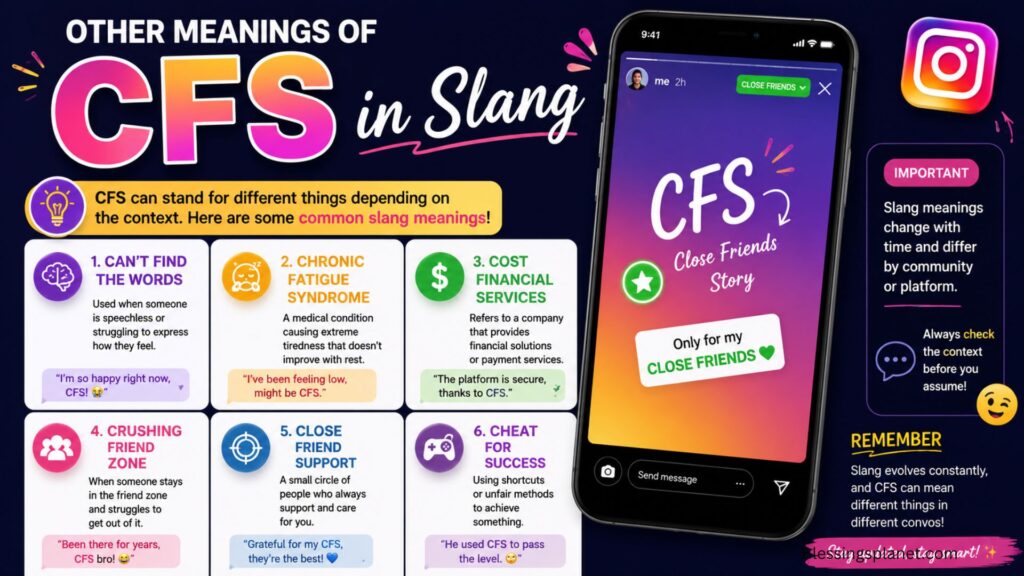
Outside Instagram, CFS occasionally appears in general texting as shorthand for other phrases depending on context, though “Close Friends Story” remains by far the dominant meaning within social media conversations.
CFS Meaning on TikTok and Snapchat
On other platforms, “close friends” style features exist too — Snapchat has its own private story options — but the abbreviation CFS is most strongly tied to Instagram specifically, since that’s the platform that popularized the “Close Friends” naming convention.
Rare Alternative Meanings
In unrelated contexts, CFS can stand for things like “Chronic Fatigue Syndrome” in medical settings or various organizational names in business contexts. These meanings almost never apply within Instagram’s social conversations.
How Context Changes Meaning
As with most internet abbreviations, context is everything. On Instagram, near stories, captions, or DMs, CFS overwhelmingly means Close Friends Story. Outside that environment, it’s worth checking the surrounding conversation before assuming.
Benefits of Using CFS on Instagram
Better Privacy and Control
CFS gives users a genuine layer of control over who sees their content, without needing to make their entire account private.
Stronger Personal Connections
Smaller audiences tend to produce more meaningful interactions — comments, replies, and reactions that feel personal rather than performative.
Authentic Content Sharing
Because the pressure of a large audience is removed, content shared through CFS tends to be more honest and less curated.
Reduced Social Pressure
Users often report feeling less anxious about likes, views, or public perception when posting to a smaller, trusted group.
Pros and Cons of CFS Feature
Key Advantages of Close Friends Story
- Selective, controllable audience
- Stronger sense of privacy
- More authentic self-expression
- Useful for testing content
Limitations and Drawbacks
- Requires manual list management
- Can create awkwardness if someone is excluded
- Limited reach compared to public stories
Social Misunderstandings
Being left off a CFS list can sometimes cause hurt feelings or misinterpretation, especially among close friend groups where inclusion feels significant.
When Not to Use CFS
CFS isn’t ideal for content meant to build a public brand, grow a following, or reach a wide audience — its entire purpose works against visibility.
Common Mistakes When Using CFS
Adding Wrong Audience
Some users accidentally add people to their Close Friends list who don’t belong there, defeating the purpose of the feature entirely.
Oversharing Private Content
Even within a “close” audience, it’s worth remembering screenshots are always possible. Treating CFS as completely leak-proof is a common and risky mistake.
Misinterpreting the Term
New users sometimes assume CFS refers to something else entirely, leading to confusion in conversations where the term is used casually.
Ignoring Privacy Settings
Failing to regularly review and update the Close Friends list can lead to outdated or inappropriate audiences seeing sensitive content.
Safety and Privacy Tips for CFS
Managing Your Close Friends List Safely
Review the list periodically. Relationships change, and a list that made sense a year ago may not reflect who someone actually trusts today.
Avoiding Digital Oversharing
Even in a smaller circle, it’s wise to think twice before sharing anything that could cause harm if it were seen outside that group.
Understanding Audience Boundaries
Being clear with yourself about why someone is on the list — and what you’re comfortable with them seeing — helps prevent regret later.
Protecting Personal Information
Avoid sharing identifying details like locations, schedules, or sensitive personal information even within a trusted circle, since privacy online is never fully guaranteed.
CFS vs Other Instagram Features
CFS vs Public Story
A public story reaches every follower (or everyone, on public accounts); a CFS reaches only the selected list. The content format is identical — the audience is what changes.
CFS vs Private Account
A private account restricts an entire profile to approved followers. CFS restricts only specific stories, allowing someone to remain publicly visible overall while still keeping certain content exclusive.
CFS vs Direct Messages
DMs are one-to-one or small-group conversations. CFS is broadcast-style — one story shared to many people on a list at once, without individual conversation threads.
CFS vs Broadcast Channels
Broadcast Channels let creators send messages to a large audience in a one-directional format. CFS, by contrast, is intimate and limited by design, prioritizing closeness over reach.
How Influencers and Creators Use CFS
Building Exclusive Communities
Many creators use Close Friends lists to build a smaller, dedicated community that feels more connected than their general following.
Sharing Premium or Behind-the-Scenes Content
Behind-the-scenes footage, early announcements, or personal reflections often go to CFS audiences as a way of rewarding loyal followers.
Increasing Engagement and Trust
Smaller audiences tend to interact more, and that engagement can strengthen trust between a creator and their most dedicated followers.
Monetization and Strategy Insights
Some creators use CFS-style exclusivity as an entry point toward paid subscription models elsewhere, treating the free version as a taste of what deeper access might offer.
How to Use CFS for Growth and Engagement
Building Deeper Audience Relationships
Consistently sharing meaningful content with a smaller circle helps deepen relationships that broad, public posting often can’t achieve.
Using Exclusivity as a Strategy
Scarcity naturally increases perceived value. Content that’s harder to access — even socially, not financially — tends to feel more special.
Testing Content Performance
Creators can gauge how an idea lands with a trusted audience before deciding whether it’s worth sharing publicly, reducing the risk of a post falling flat.
Creating Loyal Followers
Over time, consistent exclusive content builds a sense of loyalty and belonging that keeps a smaller audience deeply engaged.
Frequently Asked Questions
What does CFS mean on Instagram?
CFS stands for Close Friends Story — a story shared only with a user’s selected Close Friends list rather than their entire following.
How do I know if a story is a CFS?
Look for a green ring around the profile picture instead of the standard multicolor story ring. That green ring indicates Close Friends content.
Can I see someone’s CFS if I’m not on their list?
No. If you’re not added to that person’s Close Friends list, their Close Friends stories won’t appear in your feed at all.
How do I add someone to my Close Friends list?
Go to your profile, tap the menu icon, select “Close Friends,” and search for and add the people you want included.
Does someone get notified when I add them to Close Friends?
No, Instagram does not notify users when they’re added or removed from someone’s Close Friends list.
Is CFS the same as a private Instagram account?
No. A private account restricts your entire profile to approved followers, while CFS only restricts specific stories to a chosen subset of people.
Why do people use CFS instead of just posting normally?
CFS allows more personal, honest sharing without the pressure of a large, mixed audience seeing content meant for close connections only.
Conclusion
CFS might look like just another three-letter abbreviation floating around Instagram, but it represents something bigger: a shift toward more intentional, controlled sharing on a platform that’s often criticized for encouraging oversharing to the entire world.
Understanding what CFS means — Close Friends Story — isn’t just about decoding slang. It’s about recognizing how people are quietly redesigning their own digital boundaries, choosing who gets access to their real, unfiltered moments, and who only sees the curated highlight reel.
Whether you’re using CFS yourself, wondering why you weren’t added to someone else’s list, or simply trying to keep up with the language of modern social media, one thing is clear: the little green ring means more than it looks like at first glance.

Robert Jr is a passionate writer dedicated to spreading peace, hope, and spiritual comfort through meaningful words. With a deep love for faith-based wisdom, he writes heartfelt blessings and uplifting prayers that inspire readers to reconnect with their inner strength and divine guidance.
As the voice behind BlessingsPlanet.com, Robert believes that even a few gentle words can brighten someone’s day, calm a troubled heart, and remind us all of the power of faith. His mission is to create a space where people from all walks of life can find encouragement, healing, and spiritual clarity.
Through each prayer, blessing, and reflection, Robert Jr aims to uplift souls, nurture positivity, and help readers feel closer to God’s light—one message at a time.